Yelp won the internet and lost the neighborhood. Its rankings are a pay-to-play battleground, its review system is a war zone of takedowns and suspicion, and a business in a town of 40,000 gets the same algorithmic indifference as a taco chain in Los Angeles. Ask a local business owner how they feel about the big aggregators and you'll hear the same thing everywhere: expensive, opaque, and run by people who couldn't find the town on a map.
That's exactly why starting a local business directory in 2026 is a better idea than it sounds. The demand never went anywhere — "plumber near me" and "best salon in [your town]" are searched thousands of times a month in every metro on earth. What's missing is the supply side the big platforms structurally can't offer: a directory for one place, curated by someone who actually knows it, where a listing costs a flat fee instead of an ad auction.
This guide walks through how to start a local business directory step by step: picking your patch, building the site, seeding the first listings, getting businesses to claim them, and turning the whole thing into recurring revenue.
Why local business directories still work
- The long tail is wide open. National players optimize for "dentist Chicago." Nobody is seriously competing for "emergency plumber Round Rock" or "kid-friendly cafés in Ghent" — searches with small volume individually and huge volume in aggregate.
- Curation is the product. A directory where a local person has vetted every entry beats an algorithm sorting 400 paid results. Visitors can feel the difference immediately.
- Merchants are actively looking for an alternative. Small businesses resent what the big platforms charge and how little control they get. A local directory with a human behind it, flat pricing, and a real map pin is an easy conversation.
- It compounds. Every listing is a page, every category is a page, every city is a filter — a directory is an SEO asset that gets stronger with each entry you add.
Step 1: Pick your patch
Two proven shapes for a local business directory:
One city, all categories — the "best of [your town]" destination: restaurants, salons, gyms, plumbers, clinics. Your identity is geographic, and your advantage is that you can physically walk into every business you list. This is the strongest starting point for most people.
One vertical, one metro — home services across a metro area, wellness providers, kid-friendly businesses. Pick this when you already know an industry deeply or have an audience in it.
Either way, start narrower than feels comfortable. Fifty great listings in one city beat five hundred scattered across a state — density is what makes a local directory feel alive, and it's what makes the city search and map actually useful.
Step 2: Create your business directory website
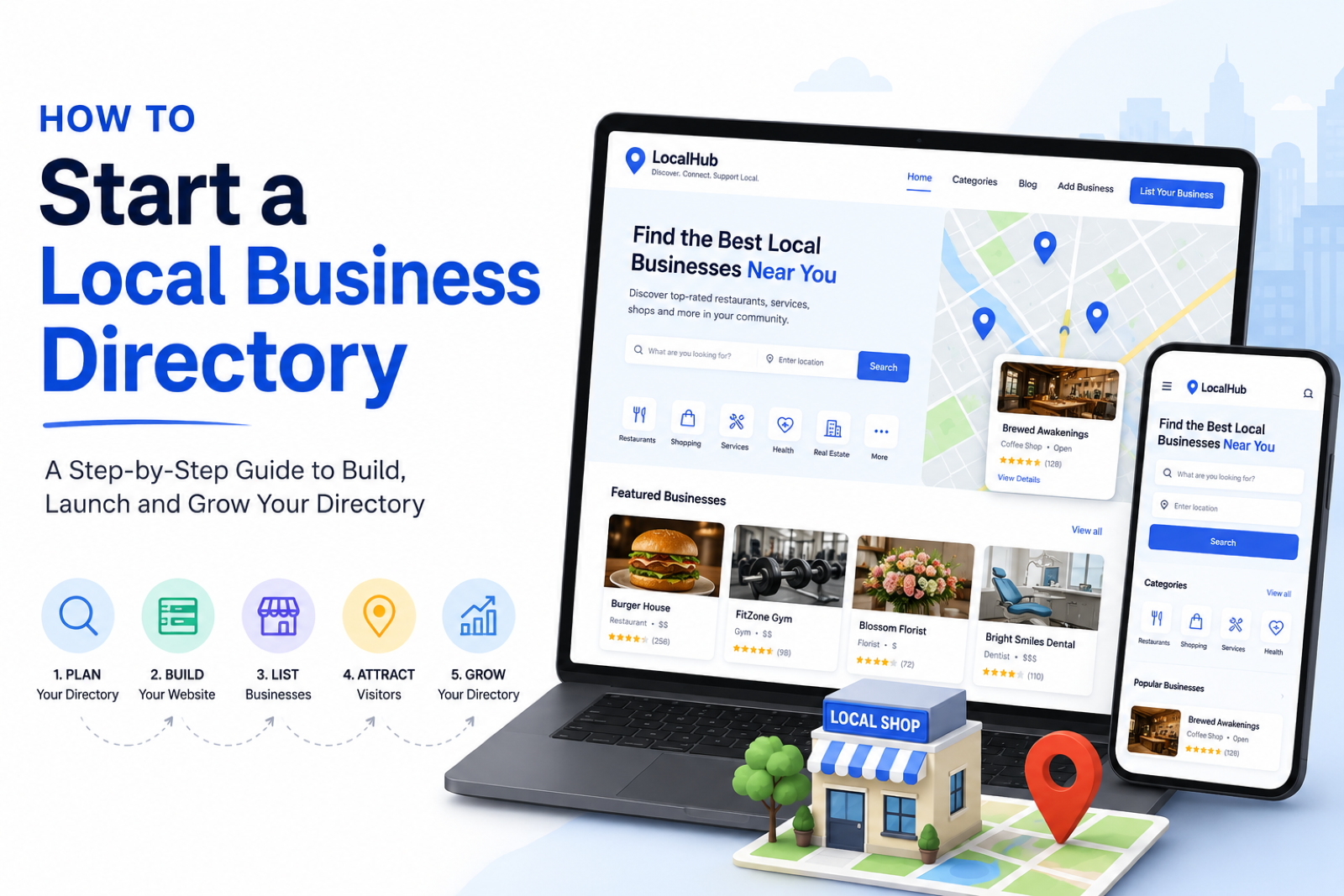
You don't need to code anything or duct-tape plugins together, a modern business directory software handles that. But to build a business directory website that behaves like a local one, you need mechanics generic site builders don't have:
- Two-field search. Local visitors think in two parts — what they need and where. A single search box makes them do the work; a keyword field plus a city field that autocompletes from your own listings does it for them.
- A results map that earns its place. Pins beside the results, a preview card when you hover one, and filters that apply to the list and the map together. On mobile, a list-first view with a map toggle.
- Open Now and hours. "Is it open right now?" is half of local search intent. Hours belong on every listing, with a live open/closed badge doing the math.
- Reviews. Star ratings are the trust currency of local. They belong on the cards, not buried on the detail page.
- Service areas. Plumbers and mobile groomers don't have storefronts — they have coverage. Your directory needs "Serves Austin, Round Rock" as a first-class concept, not a hack.
- Claimable listings. You'll seed listings yourself; the businesses should be able to claim and manage them later. Claims are also your first revenue lever.
Directify's local business directory template ships all of this as the default: the two-field search with city autocomplete, a results map with hover preview cards, Open Now badges computed from each business's hours, service areas, reviews switched on, and a Popular Areas section built from your own listing data. Describe your site to the AI builder — "home service providers in Austin" — and it scaffolds the whole directory in about a minute: business fields (price range, hours, amenities, service areas, booking link), categories, and demo listings already grouped in one metro so the search and map work on the first page load. Cities are detected automatically from each listing's address during geocoding, so the location features run with zero setup. Connect your domain, adjust the palette in the Theme Editor, and the build step is done the same afternoon.
Step 3: Seed the first 50 listings yourself
Local directories bootstrap supply-side: listings first, audience second, businesses paying third. Don't wait for anyone to submit — curate:
- Write the list you already know. Start with the businesses you'd personally recommend — that judgment is your moat.
- Aim for category coverage, not volume. Eight categories with six good listings each beats one category with fifty. Coverage is what makes the site read as the directory for your town.
- Fill in the details that matter locally. Address (the map pin comes free), hours, phone, a photo. A listing a visitor can act on — call, visit, book — is worth ten thin ones.
At this stage you're building the asset. Fifty solid listings is one focused week of evenings, and it's the last unpaid work the directory should ever need from you.
Step 4: Get businesses to claim their listings
Now flip the dynamic: instead of asking businesses for permission to list them, you're telling them they're already listed.
The outreach is one honest sentence: "Your business is on [directory] — you can claim the listing to keep the hours current, add photos, and reply to reviews." Claiming is free (or your entry-level paid tier), takes minutes, and converts a static entry into a relationship. Every claimed listing is a business owner with a login, an emotional stake in the page — and an upgrade path.
Keep public submissions on with moderation, so new businesses can add themselves into your approval queue. You stay the editor; the town does some of the typing.
Step 5: Rank for "[service] in [city]" searches
Your directory's traffic engine is the page structure itself:
- Category pages are your money pages — "Plumbers", "Salons", "Medical Clinics" each collect the local long-tail searches for that service.
- City filtering captures the where half — visitors and search engines both get clean URLs for city-scoped results.
- Structured data does the whispering. Every listing should emit LocalBusiness schema with coordinates and reviews so search engines understand exactly what each page is (with the Directify template, this is automatic — including breadcrumbs and ItemList markup).
- Reviews feed the machine. Fresh review content keeps pages alive between listing updates, and star ratings earn rich results.
Publish a short guide or roundup weekly — "Best late-night eats in [town]" — and link it to your categories. Local content plus a structured directory is a combination national aggregators can't out-write.
Step 6: Turn on monetization
When the directory is visibly alive and businesses have claimed their listings, convert:
- Featured placement — the top of the category and the homepage spotlight. Inventory is limited by design, which is exactly why it sells.
- Paid claims and listing plans — a flat monthly or yearly fee for a managed listing with photos, booking links, and review replies. Modest fees across fifty businesses is real recurring revenue.
- Leads — for service verticals, "requests a quote" inquiries are worth more than clicks, and businesses know it.
The pitch writes itself because the value is visible: the business owner can see their pin on the map, their reviews coming in, and their phone number one tap from a search you rank for.
How much does it cost to start a business directory?
Modest, front to back. A domain runs $10–15 a year. Directify starts at $12/month, with the local business template — and every other template — included on all plans, and there's a free 7-day trial to build on. The real investment is the focused week of seeding your first fifty listings and the outreach that follows. No developers, no map API access keys to configure, no plugin stack to maintain.
Mistakes to skip
- Going too wide too early. "Businesses in Texas" is a research project. "Businesses in Waco" is a business.
- Launching empty and hoping for submissions. Supply is your job; do it first.
- Skipping addresses and hours. A local directory without map pins and Open Now status is a phone book. The location mechanics are the product.
- Selling before there's anything to buy. Featured placement on an empty category converts nobody. Seed, claim, then charge.
Start this week
The build is the easy part now — the local business template gets a working directory live in an afternoon, map and all. The listings are the real work, and also the moat: nobody at a national aggregator knows your town like you do. Start your free 7-day trial, scaffold the site with AI, and spend your energy where it compounds — on the fifty local businesses that will become your first claimed listings and your first paying subscribers.
Ready to Build Your Directory?
Start creating your professional directory website today with Directify's no-code platform.
Get Started Free