Everyone who wants to build an online marketplace has heard the same advice: raise money, hire developers, integrate payments, build escrow, take a commission. That's the Airbnb playbook — and for the marketplace most people actually want to build, it's the wrong one.
Look at the marketplaces that quietly work: a used camera gear exchange, a farm equipment board, a campus buy-and-sell, a collectibles market for one obsessive niche. The sale happens between buyer and seller — cash, bank transfer, whatever they agree on. What the platform provides is the part that's genuinely hard to bootstrap: listings buyers trust, sellers people recognize, and an audience that keeps coming back. None of that requires a checkout.
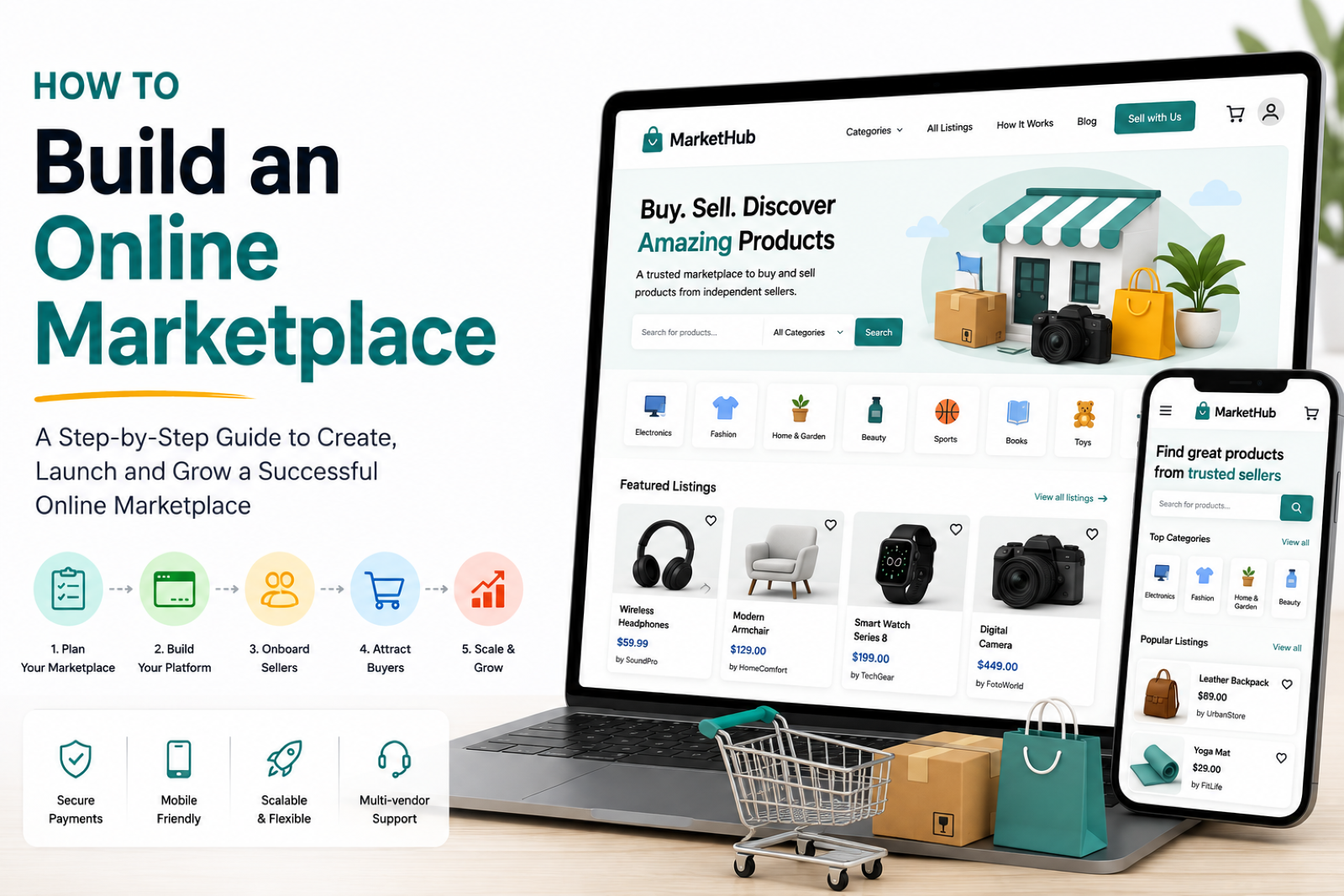
This guide walks through how to build an online marketplace the lean way: pick a niche where you know the buyers, launch a listings-first site in an afternoon, seed real supply, and charge sellers flat fees instead of taking a cut of anyone's sale.
The two kinds of marketplace (and why it matters)
Transactional marketplaces process the payment between buyer and seller — think Airbnb or StockX. They need checkout, escrow-style payouts, refund handling, and compliance. Platforms built for this exist, and they price accordingly: on Sharetribe, the reference no-code directory builder option, a live marketplace starts at $99/month billed yearly and transactions beyond a monthly allowance are metered.
Listing marketplaces connect buyers to sellers and step out of the way — think Craigslist, Facebook Marketplace, or any classifieds site that ever worked. The platform's job is discovery and trust: searchable listings with real prices and honest condition notes, seller profiles with track records, and proof that things actually sell.
Here's the part the "build the next Airbnb" advice skips: almost every niche marketplace idea is a listing marketplace. Used goods change hands in person. Equipment gets inspected before money moves. Collectors want to talk before they buy. Adding a checkout to those transactions doesn't add value — it adds friction, fees, and liability. Start with listings; you can always add payments later, once there's an audience worth building them for.
Step 1: Pick a niche where you know the buyers
"A marketplace for everything" is Craigslist, and Craigslist already exists. The openings are narrow and deep:
- Gear niches — cameras, bikes, synths, dive equipment, tools. Enthusiasts buy and sell constantly and hate the generic platforms' noise and scams.
- Local classifieds — one town or campus, all categories. Your advantage is density and trust: buyers can actually meet the sellers.
- Equipment verticals — farm, restaurant, lab, construction. High prices, informed buyers, and sellers who will gladly pay for placement.
- Collectibles — vinyl, trading cards, vintage anything. Condition grading and seller reputation matter more here than anywhere, which is exactly what a niche marketplace does better than eBay's flea-market sprawl.
The test: could you personally post the first thirty listings, or recruit five sellers who would? If yes, you know the niche well enough. If no, pick a narrower one.
Step 2: Create the marketplace website
To create a marketplace website that buyers take seriously, a grid of cards isn't enough. The mechanics that make a marketplace feel like a marketplace:
- The price is the headline. Buyers scan prices first. Cards should lead with the price, backed by a condition badge — New, Like New, Good, Fair, For Parts — and the item's location.
- Sellers need faces. Anonymous sellers kill marketplaces. Every seller should have a public profile: photo, ratings, listing history, member-since date — linked from every card they post.
- Filters that match how buyers shop. Price min/max, condition, delivery options, and price sorting in both directions. A buyer with $500 and a condition floor should reach their shortlist in two clicks.
- Sold has to be visible. A Sold badge on ended listings and a "just sold" section on the homepage are your conversion engine — nothing recruits new sellers like proof that things sell.
- Self-serve posting with moderation. Sellers post through a public form; you approve. Supply grows without you, quality stays yours.
Directify's marketplace website template ships all of this as the default: price-tag cards with condition badges, seller profiles enabled automatically under a /sellers URL, Sold tracking with a Just Sold homepage strip, price and condition filters, and a moderated submission form carrying the full classifieds field set. Describe your idea to the AI builder — "a marketplace for used camera gear" — and it scaffolds the site in about a minute: categories, the field set (price, condition, brand, delivery, open to offers), and demo sellers with listings already attached. Connect your domain, adjust the palette in the theme editor, and the build step is done the same afternoon. It's the fastest no-code marketplace builder path from idea to a site you can show sellers.
Step 3: Seed real supply
Marketplaces bootstrap supply-first: listings, then buyers, then sellers paying. Nobody browses an empty market twice.
- Post the first 30–50 listings yourself. Your own gear, consignments from friends, or listings you assemble with sellers' permission. Write them like a good classified ad — the item plus its one standout spec ("Sony A7 III — 12k shutter count"), a realistic price, honest condition notes.
- Recruit five founding sellers. People with reputations in the niche and stock that turns over. Offer free listings and a featured spot; their names on seller profiles are your launch credibility.
- Photograph everything. A marketplace is a visual scan. Listings without photos read as scams — don't publish them.
Step 4: Make the market visibly move
A marketplace's most persuasive page is evidence of sales. From day one:
- Mark sold items sold — never delete them. The Sold badge and the Just Sold strip are social proof compounding in public.
- Keep fresh stock arriving. Buyers return on a rhythm; even five new listings a week reads as alive. This is what your founding sellers are for.
- Let the counts talk. Listings, sellers, items sold this week — surface them on the homepage and in your outreach to new sellers.
Step 5: Charge the sellers, not the sales
When supply is real and things are selling, switch on revenue — without touching the transaction:
- Paid listing submissions and packages — a flat fee per listing or a bundle. Cheap for sellers, real income across a hundred listings a month.
- Featured placement — the top of the category and the homepage spotlight. Limited by design, which is why it sells.
- Verified seller upgrades — a badge that earns trust and a small recurring fee.
- Banner ads — the niche's brands and repair shops want to be where the buyers are.
The pitch to sellers writes itself: keep 100% of your sale, pay a flat fee for placement. Against platforms that meter every transaction, "no commission" is the whole argument.
How much does it cost to build a marketplace website?
Modest, front to back. A domain runs $10–15 a year. Directify starts free, with paid plans from $12/month — the marketplace template and every other template included, no per-listing fees, no transaction metering. The real investment is the week of seeding your first fifty listings and the outreach to your founding sellers. Compare that to transactional marketplace platforms (a live site from $99/month before metered fees) or custom development (a five-figure build before the first listing exists), and the lean path is not just cheaper — it's faster to the only thing that matters early: finding out whether your niche wants this marketplace at all.
Mistakes to skip
- Building checkout before an audience. Payments are the reward for traction, not the path to it.
- Launching empty. Supply is your job. Do it before you tell anyone the site exists.
- Letting sellers stay anonymous. Profiles with history are the difference between a marketplace and a scam board.
- Deleting sold listings. You're throwing away your best marketing.
- Going broad. "Buy and sell anything" competes with Facebook. "Buy and sell film cameras" competes with nobody.
Start this week
The build is the easy part now — the marketplace template gets a working site live in an afternoon, seller profiles and all. The supply is the real work, and also the moat: nobody at a generic platform knows your niche's buyers like you do. Start your free 7-day trial, scaffold the site with AI, and spend your energy on the fifty listings and five founding sellers that turn a website into a market.
Ready to Build Your Directory?
Start creating your professional directory website today with Directify's no-code platform.
Get Started Free