Most directory websites fail before the first listing goes in. Not because the site was bad, but because nobody checked whether anyone was searching for it, or whether three established directories already owned page one. The owner spent weeks on categories and design, launched, and got the same forty visitors a month for a year.
The check that prevents this takes about a minute, and it has three questions: is there demand, who already serves it, and is there enough to list? This guide walks through each one, with the numbers that matter and the thresholds we use, then shows how to run the whole check automatically with a free tool we built for it.
Why most directory ideas fail
After watching thousands of directories launch on Directify, the pattern is clear. The ones that stall share one of three problems:
- No demand. "Sustainable business consultancy directory" sounds like a niche. Nobody types it into Google, and nobody types anything close to it either.
- Too much competition. "Plumbers" has demand to spare, but if Yelp, Angi, Thumbtack and two dedicated plumber directories hold the whole first page, a new site needs years of link building to get a look in.
- Not enough to list. A directory of five music teachers is a list, not a directory. Visitors leave, businesses don't bother claiming their page, and the site never gets the content that would make it rank.
The good news is that all three are measurable before you build anything.
Step 1: Measure demand
Demand is the monthly search volume for the niche, across the whole cluster of ways people search for it: dog groomers, dog groomers near me, best dog groomers, dog grooming austin, and so on. One keyword tells you little; the cluster tells you whether a directory can earn traffic.
Two numbers matter:
- National volume for the niche. Under a few thousand searches a month is thin; 10,000 or more means the topic has an audience; 100,000 or more is a real market.
- Local volume if the directory is for a city. A city directory lives on
{niche} {city}and{niche} near mesearches from that area. For a single city, 1,000 local searches a month is a good sign, 100 is a hobby.
Also look at keyword difficulty: a cluster where most keywords sit under 30 is one a new site can rank for; a cluster where everything is 60 or higher is a long game.
Where to get it: Google Keyword Planner gives you ranges for free, and most SEO tools (Ahrefs, Semrush, and similar) give exact volumes and difficulty. Pull the top 10 to 20 keywords for the niche and add up the volume.
Step 2: Read the competition the right way
Volume means nothing until you know who's already ranking. Search the main keyword and look at the first page. Each result falls into one of three types, and they do not weigh the same:
- Dedicated directories. A site whose whole job is listing this niche ("GroomFinder", "FindAPlumber"). Every one of these on page one is a direct competitor that already has the content you're about to create. Two or more is a crowded niche. Four or more is usually a no.
- Aggregators. Yelp, Yellow Pages, Angi, Thumbtack, Tripadvisor, Google's own business results. They're everywhere, and they're beatable on specifics: they rank for the generic keyword but their pages for a narrow niche are thin. One to three of them is normal and fine.
- Single business sites and content pages. A groomer's own website, a blog post, a "10 best" article on a small site. Business sites are not beatable (Google wants to show them), but content pages from small sites are the spots a directory can take, because a page listing 300 groomers with reviews beats a listicle every time.
So the question isn't "how many results are there", it's "how many spots on page one could a good directory realistically take". Three or more beatable spots with no dedicated directory is an open niche. Zero beatable spots behind two dedicated directories is a closed one, regardless of volume.
Step 3: Check supply
A directory needs things to list. For a local niche, count the businesses: a Google Maps search for the niche in the city tells you fast. The thresholds we use:
- 300+ businesses: plenty. You can launch with a curated 50 and grow.
- 100 to 300: a solid directory, though you'll list most of them yourself.
- 30 to 100: workable for a high-value niche (wedding venues, med spas), thin for a low-value one.
- Under 30: a list, not a directory. Widen the area or the niche.
For national, non-local niches (SaaS tools, Chrome extensions, newsletters) supply is rarely the problem; the question is whether the items are findable and whether you can keep up with new ones.
Step 4: Put it together
A simple way to score an idea is to give each part points and add them up, which is exactly what our validator does:
- Demand, up to 45 points, on a log scale so 10x more searches is worth a step, not a leap.
- Gap, up to 35 points: start from a small base, add points for each beatable spot on page one, subtract for each dedicated directory and for aggregators beyond the usual three.
- Supply, up to 20 points, from the business count (a flat 10 for niches with no location).
Out of 100: 70 or more is a strong opportunity, 55 to 69 is worth a try, 40 to 54 is crowded or small, and under 40 is hard. On the first 50 niches we scored this way, the median was 57, and only a handful cleared 70, which is about right. Most niches are worth a try. Few are wide open.
Three real reports show how the parts interact:
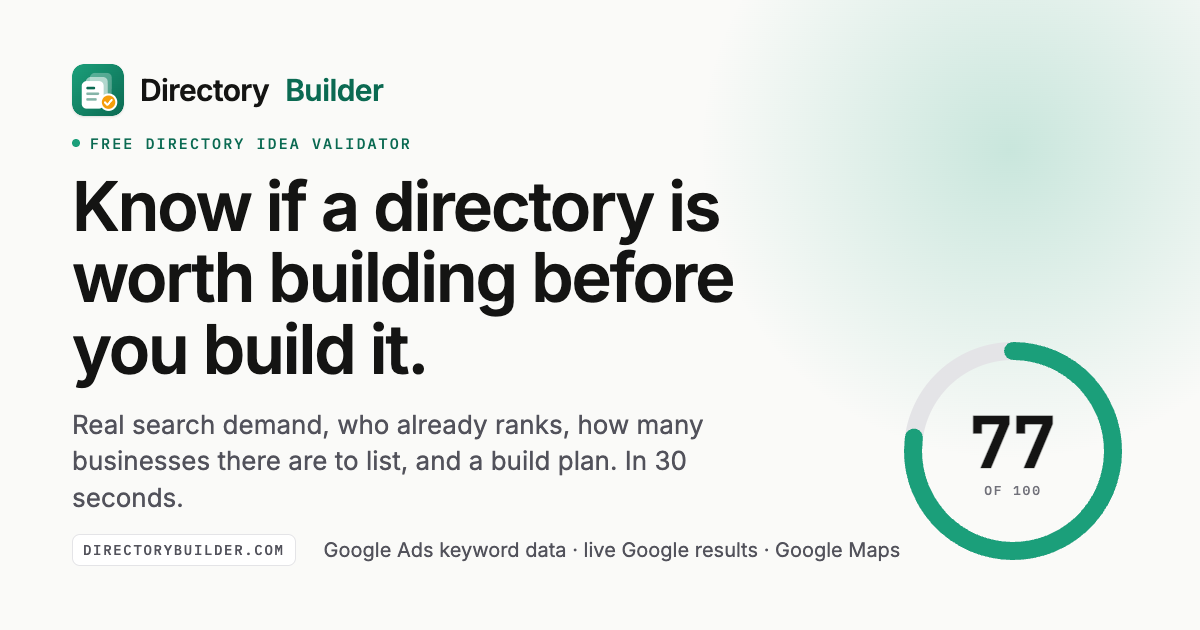
- Roofing contractors in Nashville, 77/100. 446,000 national searches, 1,610 local, no dedicated directory on page one, three aggregators, and 329 roofers to list. Strong demand, open competition, deep supply.
- Dog groomers in Austin, 54/100. Bigger demand than roofing (2,720 local searches) and no dedicated directory, but only 112 groomers and a page one that's mostly the groomers' own sites, which can't be displaced. Crowded or small, despite the volume.
- Music teachers in Atlanta, 21/100. 140 local searches, eight dedicated directories already on page one, and five businesses found. Every part fails.
Nobody would have guessed the dog groomers result from the volume alone. That's the point of running the numbers.
Run the whole check in one minute
We built DirectoryBuilder.com to do all four steps at once. Type a niche, add a city if it's local, and about a minute later you get a public report with the search demand and top keywords, every page-one competitor classified as directory, aggregator or business site, the number of businesses to list with samples, the score with its three parts, and a short launch plan: name ideas, categories, first content and how to get the first listings.
It's free. Guests can start one new report a day, a free account three, and every report already in the library is free to read. If the score is good, the report ends with a Build this directory button that opens Directify with the idea pre-filled, so the AI builder sets up the site, categories and fields from the plan you just read.
What to do with a low score
A low score isn't the end of the idea; it tells you which part to change.
- Low demand: widen the niche one step ("vegan bakeries" to "vegan restaurants") or go national instead of local.
- Crowded page one: narrow instead. "Wedding photographers" is owned by aggregators; "elopement photographers" or "documentary wedding photographers" usually isn't. Dedicated directories rank for the broad term and ignore the sub-niche.
- Thin supply: widen the area (metro instead of city, state instead of metro) or add adjacent categories the same visitor wants.
Run the new version. A few iterations usually find an angle that scores 60 or more, and that's a directory worth a weekend.
Validate first, then build
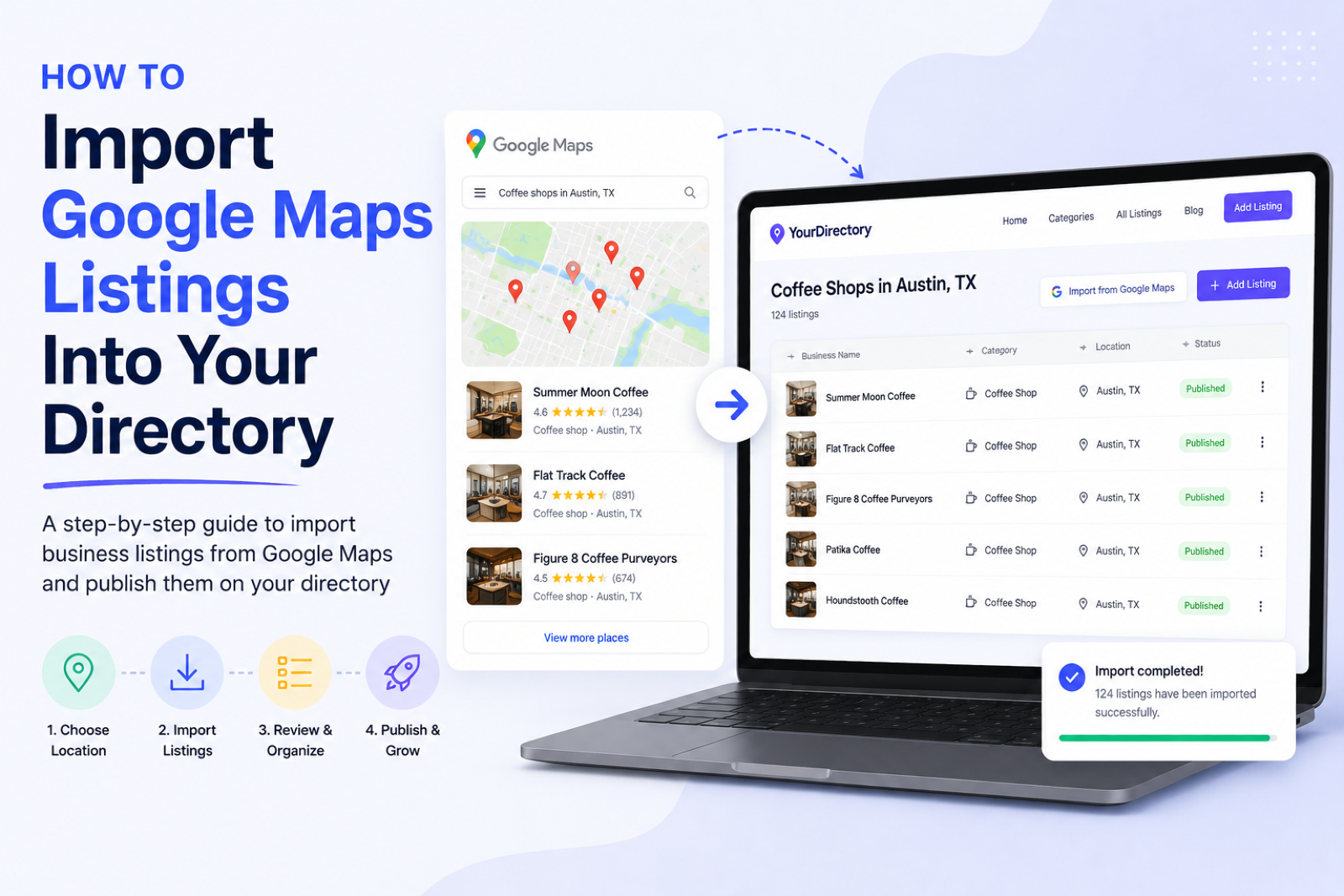
The order matters: demand, competition, supply, then the build. Run the numbers on the niche you have in mind, and on the two or three variations next to it, before you pick a domain. When one of them comes back strong, build it with Directify: describe the idea, let the AI set up the directory, import the first listings from Google Maps, and start your free 7-day trial with the site already live.
Ready to Build Your Directory?
Start creating your professional directory website today with Directify's no-code platform.
Get Started Free